

Most people rent a storage unit thinking in terms of floor space, then quickly discover that it feels full long before all their belongings are inside. In reality, up to forty or fifty percent of the available vertical space is often left unused because boxes are stacked only to chest height and shelves are missing or poorly planned. This wasted height turns storage into a frustrating game of rearranging piles every time you need something.
Vertical organization offers a simple but powerful solution. By treating your unit as a three dimensional space instead of a flat room, you unlock hidden capacity, create safer stacking systems, and make every item easier to access. With the right setup, you gain more usable space, reduce stress, and stop digging through unstable towers just to reach a single box.
Why Vertical Organization matters in Storage Units?
Thinking only in terms of square footage is one of the biggest mistakes people make when organizing a storage unit. When you focus only on floor space, you ignore a huge portion of the capacity you are actually paying for. Vertical organization shifts your mindset from a flat room to a three dimensional space where height is just as valuable as width and depth.
This is where the idea of cubic footage versus square footage becomes critical. A 10×10 unit with a 9 foot ceiling does not offer just 100 square feet, it provides 900 cubic feet of usable volume. If boxes are stacked only to chest height, more than half of that space is wasted. Using shelving and safe vertical stacking allows you to take advantage of the full height and dramatically increase how much your unit can hold.
The right shelving systems for Vertical Storage
Choosing the right shelving system is the foundation of successful vertical organization because it determines how safely and efficiently you can use the full height of your storage unit.
Metal Shelving | The Best Long-Term Investment
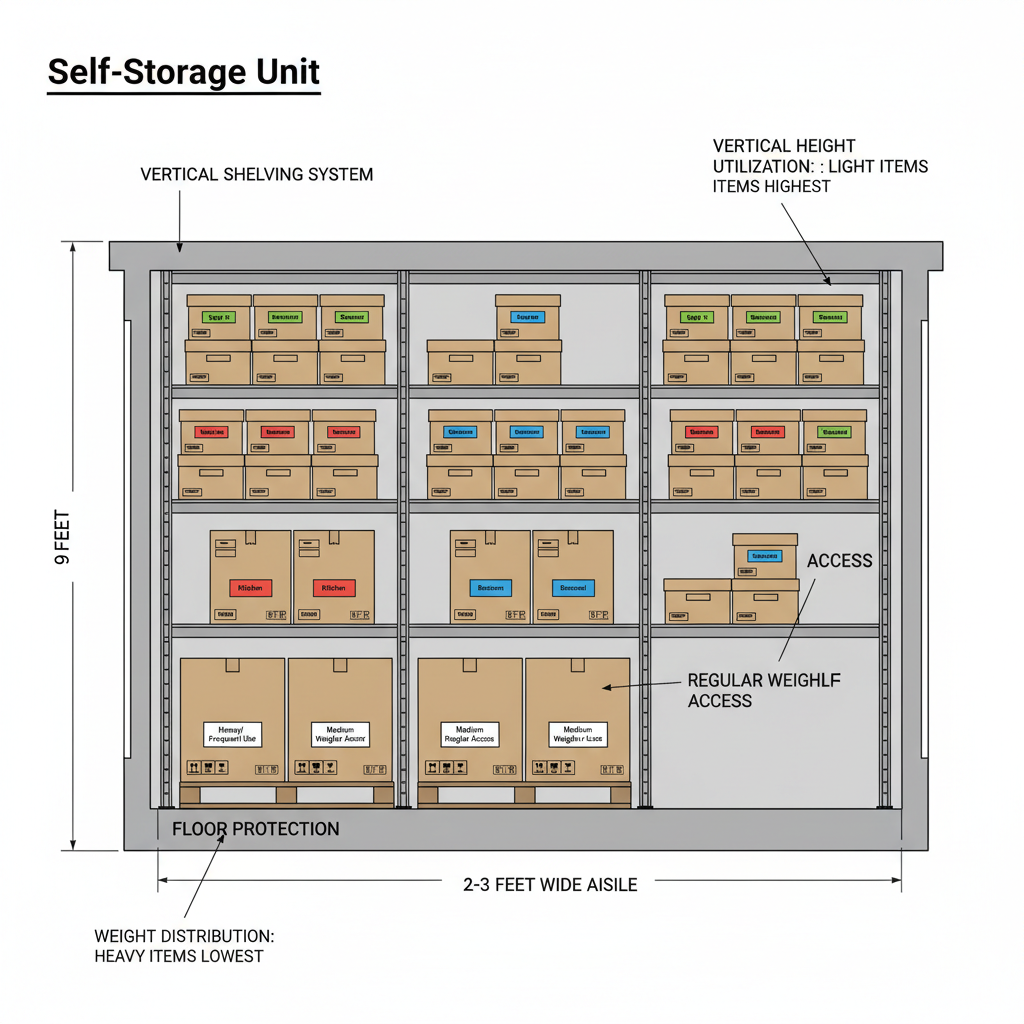
Metal shelving is the best long term investment for most storage units thanks to its high weight capacity, excellent durability, and adjustable shelf heights. These units can support hundreds of pounds per shelf, making them ideal for heavy boxes, tools, and business inventory, and the ability to customize spacing ensures that no vertical space is wasted.
Plastic and Wire Shelving | When Are They Useful?
Plastic and wire shelving are useful when weight is moderate and flexibility or airflow is a priority. Plastic shelves are lightweight, easy to move, and resistant to moisture, but they have lower load limits and may warp over time. Wire shelving allows air circulation and visibility, which helps in non-climate controlled units, though it offers less protection from dust and is not suitable for very heavy loads.
Why Uniform Sizes Change Everything?
Using boxes of the same size may seem like a small detail, but it completely transforms how efficiently a storage unit can be organized. Uniform boxes stack neatly, eliminate awkward gaps, and make planning shelf heights far easier.
When boxes are consistent, stacks become more stable and you can safely build higher without the risk of leaning towers or crushed corners. This increases the total capacity of your unit because every vertical layer fits cleanly instead of wasting space between mismatched shapes.
Each box should also stay within a manageable weight range, ideally between 40 and 50 pounds. This keeps boxes easy to lift to higher shelves and prevents structural stress that can cause stacks to shift or collapse over time.
Weight Distribution and Safe Stacking Rules
Proper weight distribution is what separates a stable, safe storage unit from one that is at constant risk of collapse, damaged items, and injuries while retrieving boxes.
Heavy Items Belong on the Bottom
Placing heavy boxes on upper shelves creates serious risks including crushed contents below, tipping hazards, and excessive stress on shelving structures. Over time, lighter boxes compress under weight and stacks become unstable, often without any visible warning signs.
Keeping dense and heavy items on the lowest shelves ensures the entire structure remains balanced and dramatically reduces the chance of accidents or broken belongings.
How High Can You Safely Stack Boxes
For most personal storage units, stacks should not exceed about five to six feet above the shelf surface, even if the ceiling is higher. This height remains reachable without ladders and reduces the danger of boxes falling during retrieval.
Whenever possible, use interlocking stacking by alternating the direction of each layer, which spreads weight more evenly and prevents shifting. Column stacking, where all boxes face the same direction, should be limited to very light and uniform loads only.
Smart Bins and Clear Aisles for Maximum Access
Clear plastic bins add an extra layer of efficiency to vertical storage because you can instantly identify what is inside without opening every container. Using a mix of large, medium, and small bins allows you to match container size to item weight and frequency of use, keeping heavier bins on lower shelves and lighter ones higher up. Even when bins are rated for heavy loads, it is best not to stack them more than four or five high in a residential unit to avoid crushing or shifting.
To make all this storage truly functional, maintain a central aisle that is about two to three feet wide running from the door to the back wall of the unit. Place shelving and stacks along the left and right sides so you can walk straight in and reach any section without moving boxes first. Door → clear aisle → shelves on both sides becomes the basic layout that turns a packed unit into a space where everything is accessible within minutes.
Don’t Store Anything Directly on the Floor
Concrete floors may look dry, but they constantly release moisture as temperatures and humidity change, which can quickly lead to mold, mildew, and damaged boxes. Items stored directly on the floor are the first to absorb this hidden dampness, often ruining cardboard, fabrics, and paper before you even notice a problem.
The solution is simple. Elevate everything using shelving units, plastic pallets, or even basic risers to create airflow between your belongings and the floor. This small gap dramatically reduces moisture exposure and keeps your storage environment healthier and safer over the long term.
Labeling and Inventory Systems That Actually Work
An effective labeling system turns your storage unit into a searchable space instead of a guessing game. Color coded labels are especially powerful because they let you identify categories at a glance, such as red for kitchen items, blue for clothing, or green for seasonal decorations. This visual system saves time and reduces the need to open multiple boxes while searching.
In addition to color, each box should include a clear and detailed description of its contents. Instead of writing something vague like kitchen, use labels such as kitchen glasses and mugs or winter clothes sweaters and coats. Numbering boxes within the same category also helps you track how many containers belong together.
For even greater control, create a simple photographic inventory on your phone. Take a quick photo of the contents before sealing each box and store the images in folders by category. When you need to find a specific item, a few seconds of scrolling is often faster than opening five boxes in the unit.
Keep Your Vertical System Working
Vertical organization is not a one time task but a living system that needs occasional attention to remain safe, efficient, and easy to use. Without maintenance, even the best organized unit can slowly drift back into clutter and instability.
At least once every three months, walk through your storage unit and perform a full inspection. Look for leaning stacks, compressed boxes, moisture buildup, or shelves that may be bending under excess weight. These small warning signs are easy to fix early but can cause major damage if ignored for long periods.
As you remove items or add new ones, the balance of your shelving system naturally changes. Take time to rebalance the load so heavier boxes stay on the lowest levels and lighter items remain on top. This keeps the structure stable and reduces the risk of tipping or collapsing shelves.
Seasonal rotation is the final step that keeps your unit practical year round. When winter approaches, move holiday décor and cold weather gear closer to the front and to reachable shelves. In spring and summer, switch these items back with warm weather equipment so you always have quick access to what you actually need.
Vertical Organization changes Everything
Vertical organization transforms a storage unit from a crowded room into a high capacity system that actually works. By using shelving, uniform boxes, smart weight distribution, clear labeling, and regular maintenance, you stop wasting the height you are paying for and start using the full cubic volume of your space. The result is more storage, fewer damaged items, and the ability to locate anything in minutes instead of hours.
You do not need to rebuild your entire unit to start seeing results. Begin with one wall, add shelving, standardize your boxes, and create a simple labeling system today. Small changes applied consistently will turn your storage unit into an organized, accessible space that stays that way.