
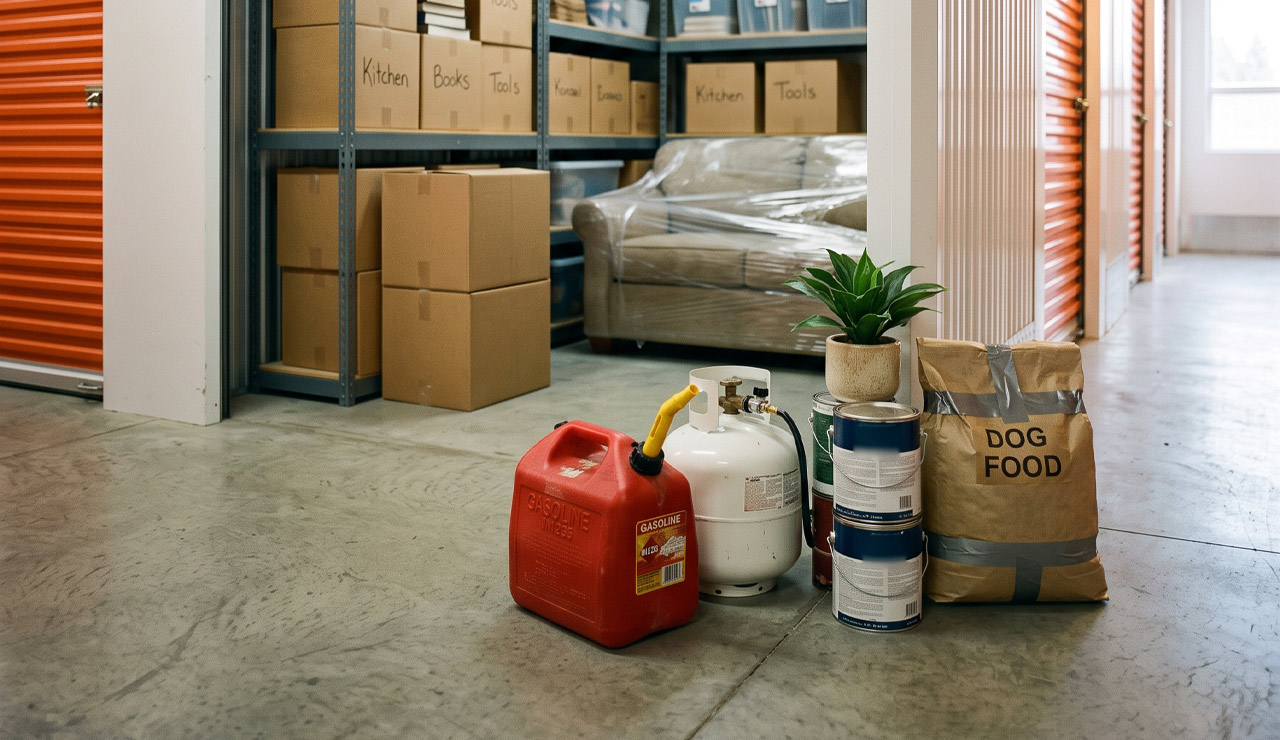
Renting a storage unit feels simple. You pick a size, sign the lease, and start filling boxes. But somewhere between the garage and the moving truck, a surprising number of people pack something that should never go inside. A half-empty jerry can for the snowblower, a bag of birdseed, a box of old paint cans, or a tote of winter clothes that was still damp from the basement. Any one of these can break your lease, void your insurance, or damage your neighbours' belongings as well as your own.
The short answer is this. Across Canada, storage facilities prohibit anything flammable, explosive, or toxic, all food and perishables, anything living, and anything illegal. Most also ban firearms and ammunition, and many restrict wet items, strong-smelling goods, and vehicles that still contain fuel. On top of that, some items are technically allowed but are a bad idea to store, especially in an unheated unit during a Canadian winter.
This guide breaks it all down so you can pack once, pack right, and avoid unpleasant surprises when you open the door months later.
| Category | Examples | Status |
|---|---|---|
| Hazardous materials | Gasoline, propane, paint thinner, fireworks, pesticides | Prohibited |
| Food and perishables | Groceries, canned goods, pet food, birdseed | Prohibited |
| Living things | People, pets, plants | Prohibited |
| Illegal or stolen goods | Stolen property, illicit drugs, counterfeit items | Prohibited |
| Firearms and ammunition | Rifles, handguns, ammunition, explosives | Prohibited at most facilities |
| Vehicles and small engines | Cars, boats, snowblowers, lawnmowers | Allowed with preparation |
| Batteries and tires | Lithium-ion packs, car batteries, tire sets | Often restricted, check your lease |
| Valuables and documents | Cash, jewellery, passports, heirlooms | Allowed but not recommended |
| Wet or scented items | Damp gear, candles, perfumes | Not recommended |
Why Storage Facilities in Canada restrict certain items?
It is easy to assume that once you pay for a unit, what goes inside is your business. In practice, your unit is one small space inside a much larger building shared with dozens or even hundreds of other renters. What you store affects everyone around you.
Storage operators in Canada restrict items for four main reasons. First, fire codes. Provincial and municipal fire regulations limit the storage of flammable and combustible materials in commercial buildings, and a single leaking fuel container in an enclosed unit can put an entire facility at risk. Second, insurance. Both the facility's commercial policy and your own tenant insurance are written with certain exclusions, and prohibited goods can make a claim collapse. Third, pests. One forgotten bag of sugar or dog food is enough to attract rodents that then move from unit to unit through gaps in the walls. Fourth, the law. Facilities cannot knowingly allow illegal goods on their property and will cooperate with police when required.
Keep in mind that every operator writes its own lease, so the exact list varies from one facility to another. A heated indoor facility in Toronto may have slightly different rules than a drive-up lot in rural Saskatchewan. The categories below cover what is banned almost everywhere, but your signed lease is always the final word.
Items That Are Prohibited in Every Canadian Storage Unit
These are the items you should never bring to any facility, regardless of the unit size, the province, or how carefully you plan to pack them.
Flammable, Explosive and Hazardous Materials
This is the category that causes the most violations, mostly because people think of a storage unit as an extension of their garage. It is not. A garage is attached to a home you monitor every day, while a storage unit sits closed and unattended for weeks at a time, often next to other people's belongings.
Prohibited items include gasoline, diesel, kerosene, and any other fuel, propane tanks and compressed gas cylinders, paint, paint thinner, varnish, and solvents, motor oil, grease, and antifreeze, pesticides, herbicides, fertilizers, and pool chemicals, bleach, acids, and strong cleaning products, and fireworks, flares, and any type of explosive.
Climate control does not make these items safe. Temperature regulation reduces some risks, but it cannot prevent leaks, fumes, or ignition in a small enclosed space. If you are clearing out a garage before a move, set these products aside early so they do not end up in a box by mistake.
Food and Perishables
Food is the single most common prohibited item found in storage units, and it is almost never intentional. It hides in the back of kitchen cabinets, in couch cushions, in picnic baskets, and in boxes packed in a hurry on moving day.
The rule is simple: no food of any kind. That includes fresh produce, dairy, and meat, but also items people assume are safe, such as sealed canned goods, dry pasta, flour, sugar, and spices. Pet food and birdseed are among the worst offenders because their smell travels and attracts rodents quickly.
Before you move furniture into storage, vacuum every couch, check every drawer, and empty every cooler. Kitchen appliances, dishes, pots, and pans are all fine to store once they are completely clean and dry.
Living Things | People, Pets and Plants
It sounds obvious, but storage facilities deal with this more often than you might think. It is illegal to live in a storage unit anywhere in Canada. Units have no proper ventilation, no plumbing, no emergency exits designed for occupancy, and in many cases no heat. Anyone found living in a unit will be evicted and may face legal consequences.
The same applies to animals of any size. Even a short stay in a closed unit can be fatal for a pet, and it is considered animal cruelty. Plants are prohibited too. Without light and water they die quickly, and as they decompose they release moisture that feeds mould and attracts insects.
Illegal, Stolen or Counterfeit Goods
A storage unit is not a place to hide anything you are not legally allowed to own. That includes stolen property, illicit drugs, counterfeit merchandise, and any goods obtained illegally. Cannabis is legal in Canada, but most facilities still prohibit storing it because of odour, pests, and provincial rules on possession limits.
Most leases give the operator the right to enter a unit when there is a reasonable suspicion of illegal activity, and facilities will comply fully with a police search warrant. Storing illegal items can lead to criminal charges on top of losing your unit and everything in it.
Firearms and Ammunition
Firearms are legal to own in Canada with the proper licence, but that does not mean you can keep them in a storage unit. The vast majority of Canadian storage facilities ban firearms, ammunition, and explosives outright in their lease, regardless of whether you hold a valid Possession and Acquisition Licence.
Even where a facility allows them, federal regulations set strict rules on how firearms must be stored, including keeping them unloaded and properly secured. An unattended storage unit rarely meets the standard of care the law expects. If you need to store firearms temporarily, talk to a licensed gun shop or a bonded firearms storage service instead. And always read your lease before assuming anything.
Items Allowed Only With Proper Preparation
Some items are welcome in most facilities, but only if you prepare them correctly first. Skipping these steps can turn an allowed item into a prohibited one.
Vehicles, Boats, Snowblowers and Lawnmowers
Cars, motorcycles, boats, RVs, snowmobiles, and small engine equipment are commonly stored across Canada, especially during the off-season. The catch is fuel. Most facilities require you to drain the tank of small engines such as lawnmowers, snowblowers, trimmers, and chainsaws completely before storage.
For cars, motorcycles, and boats, rules vary. Some facilities ask for a nearly empty tank, others allow a stabilized full tank, so confirm the policy in advance. Most will also ask you to disconnect the battery, check for leaks, and show proof that the vehicle is registered and insured. Unregistered or uninsured vehicles are usually refused.
If you are storing seasonal equipment, make it part of your routine. Run the engine dry or use the drain valve at the end of the season, clean off grass, salt, and mud, and let everything dry fully before it goes in.
Lithium-Ion Batteries and Tires
Lithium-ion batteries power almost everything we own, from e-bikes and power tools to laptops and cameras. They are also a known fire risk when damaged, overheated, or exposed to extreme cold. Many facilities now restrict large lithium batteries, such as e-bike and scooter packs, and some ban them entirely. For smaller devices, the safe approach is to remove batteries where possible, store them partially charged, and keep them away from anything flammable. Our guide on how to pack and store electronics in a storage unit covers this in detail.
Tires are another grey area. A set of winter tires is one of the most common things Canadians store, and most facilities are happy to accept them. However, some operators limit the number of tires per unit because rubber is combustible and difficult to extinguish in a fire. If you plan to store more than one set, ask first.
Appliances
Fridges, freezers, washers, dryers, and dishwashers can all go into storage, but they must be completely clean, drained, defrosted, and dry. Any water left in a hose or drum becomes a source of mould and odour. Prop fridge and freezer doors slightly open so air can circulate, and secure loose parts with tape before transport.
Items You Technically Can Store, But Shouldn't
Not everything on this list is banned. These items are usually allowed by the lease, but experience shows that storage is simply the wrong place for them.
Cash, Jewellery and Irreplaceable Documents
Storage facilities invest in cameras, gated access, and alarms, but a unit is not a vault. Cash, gold, fine jewellery, and collectible coins are better kept in a bank safety deposit box or a fireproof home safe. Many tenant insurance policies also cap or exclude coverage for cash and high-value jewellery stored off-site.
The same goes for passports, birth certificates, wills, property deeds, and original tax records. Paper is sensitive to humidity and temperature swings, and replacing these documents can take months. If you need to store business archives, use sealed plastic bins, keep them off the floor, and choose a climate-controlled unit.
Sentimental Items and Family Photos
Irreplaceable does not always mean expensive. Family photos, children's artwork, letters, and heirlooms have no replacement value, which also means insurance cannot really make you whole if they are damaged. If these items must go into storage, choose a heated, climate-controlled unit, pack photos flat in archival boxes, and consider scanning them before you store them.
Scented Items and Anything Still Damp
Scented candles, perfumes, essential oils, soaps, incense, and even taxidermy can attract insects and rodents, and strong odours can seep into neighbouring units. Candles are also a problem in summer, when temperatures inside a metal unit can soften the wax.
Anything wet or damp is an even bigger risk. Recently washed clothes, camping gear, sleeping bags, kayaks, and furniture cushions that are not fully dry will raise the humidity inside your unit and can lead to mould within weeks. Moisture does not stay in one box, it spreads to cardboard, fabric, wood, and paper around it. Let every item dry completely, ideally for a few days, before it goes into storage.
What Not to Store in an Unheated Unit During a Canadian Winter
This is where storing in Canada is truly different. Many drive-up units across the country are not heated, and in places like Winnipeg, Edmonton, or Saskatoon, temperatures inside can drop well below minus twenty for weeks at a time. The cold itself is not always the problem. The real enemy is the cycle of freezing, thawing, and condensation that happens as temperatures shift.
Avoid storing these items in an unheated unit during winter:
- Liquids of any kind. Water-based products freeze, expand, and burst their containers. Even allowed liquids such as bottled drinks, cosmetics, or latex paint can leak and ruin everything around them.
- Electronics. Screens, hard drives, and circuit boards can be damaged by condensation that forms when cold devices meet warmer air. Batteries lose capacity and can be permanently damaged by deep cold.
- Musical instruments. Pianos, guitars, violins, and drums contain wood, glue, and strings that crack, warp, or detune with extreme temperature swings.
- Photos, books, and important papers. Moisture and cold make paper brittle and cause photos to stick together.
- Leather and wood furniture. Leather can crack and wood can split when exposed to repeated freeze-thaw cycles.
- Candles, wax, and cosmetics. Wax and creams separate, crack, or change texture.
If you need to store any of these through the winter, choose a heated or climate-controlled unit. In most Canadian cities, the price difference is modest compared with the cost of replacing a laptop, a guitar, or a leather sofa. You can compare climate-controlled facilities in your province directly on StorageNear.
What Happens If You Store a Prohibited Item?
Most people who store a prohibited item do it by accident. Unfortunately, the consequences are the same either way.
The first risk is a breach of your lease. Almost every storage agreement lists prohibited items and gives the operator the right to terminate your rental if they discover them. In more serious cases, especially involving hazardous materials or suspected illegal activity, the facility can enter your unit, remove the items, and charge you for disposal or cleaning.
The second risk is financial. If a leaking fuel can, a pest infestation, or mould spreads to neighbouring units, you may be held responsible for the damage to other renters' property. That can easily add up to far more than your rent.
The third risk involves unpaid balances. If you are evicted or fall behind on payments, provincial laws such as Ontario's Repair and Storage Liens Act and British Columbia's Warehouse Lien Act allow operators to hold and eventually sell the contents of a unit to recover what is owed. If you have ever wondered where abandoned unit auctions come from, this is it, and you can learn more in our guide on how to buy abandoned storage units.
How Tenant Insurance Treats Prohibited Items
Most Canadian facilities require renters to have insurance, either through an extension of their home or tenant policy or through a plan offered by the operator. What many people do not realize is that coverage depends heavily on what is inside the unit.
Claims are commonly denied when the loss was caused by an item that was prohibited in the lease. If a fire starts because of stored gasoline or a propane tank, the insurer may refuse to pay for any of the damage. Similarly, damage caused by rodents or insects is frequently excluded, and so is mould that results from storing wet items.
Many policies also set low limits for cash, jewellery, collectibles, and electronics stored away from your home. Before you pack, call your insurer and ask three simple questions. What is covered in an off-site storage unit? What are the limits for high-value items? What exclusions apply? Keeping a detailed record of what you store also makes any claim easier, and our guide on creating a home inventory before putting things in storage walks you through it step by step.
Where to Dispose of Items You Can't Store
Once you have separated the prohibited items, you still need to do something with them. Throwing paint, propane, or chemicals in the regular garbage is not only illegal in most municipalities, it is dangerous for waste workers.
Every province has options for household hazardous waste. Most cities run depots, eco stations, or seasonal collection events where you can drop off paint, solvents, pesticides, motor oil, and cleaning products for free. Many retailers also take back specific products. Propane cylinders can usually be exchanged or returned where they were purchased, used motor oil and filters are accepted at many auto shops, and household batteries can be dropped at participating stores through the Call2Recycle program.
For food, donate unopened non-perishables to a local food bank before your move. For plants, ask friends or neighbours to adopt them, and for pets, arrange boarding or care with someone you trust. Check your municipality's website for the exact depot locations and accepted materials, since the rules vary between cities.
How to Check Your Facility's Rules Before You Rent
The simplest way to avoid problems is to ask before you sign. When you contact a facility, confirm the full list of prohibited items, whether the unit is heated or climate-controlled, what the rules are for vehicles and fuel, whether lithium batteries or tires are restricted, and what insurance is required.
Take a few minutes to read the lease itself, especially the section on prohibited goods and access rights. If something on your packing list is not mentioned, call and ask rather than assuming. A good operator will be happy to answer.
With more than 4,300 facilities listed across Canada, StorageNear lets you search storage facilities near you, compare features such as climate control, heated units, and drive-up access, and contact operators directly with no fees or markups. If you are not sure how much space you need once the prohibited items are out of the way, our free size calculator on the homepage will help you choose the right unit.
Pack Smart and Store with Confidence
Knowing what you cannot store is just as important as knowing how to pack what you can. Keep hazardous materials, food, living things, and illegal goods out entirely. Prepare vehicles and small engines properly, think twice about valuables and sentimental items, and choose a heated unit if your belongings are sensitive to the cold. Above all, read your lease and ask questions before you sign.
A few extra minutes of preparation protects your belongings, your insurance coverage, and every other renter in the building. Once your packing list is clean, find a storage facility near you and move in with confidence.