
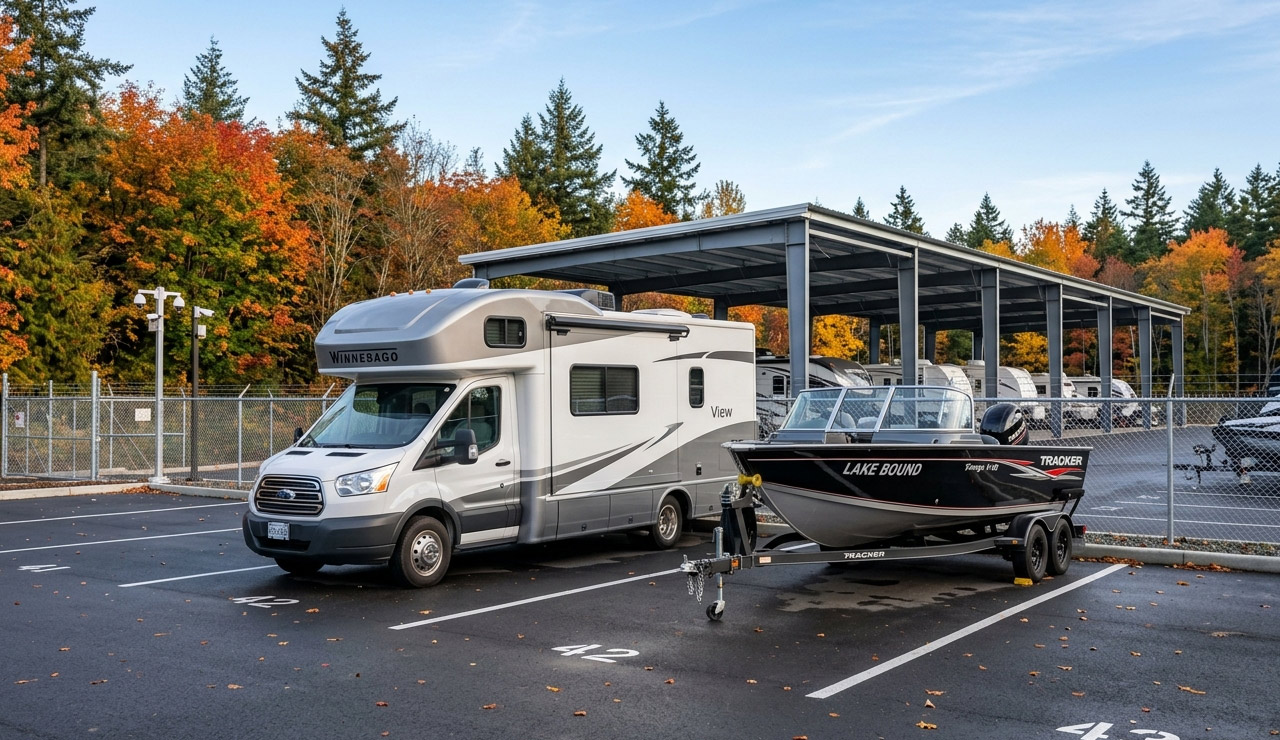
Recreational vehicles and watercraft represent significant investments and gateways to memorable adventures across Canada. Whether navigating coastal inlets in British Columbia, exploring provincial parks in Ontario, or camping through Alberta and Quebec, these vehicles deliver unmatched freedom.
However, between trips and throughout long winter months, keeping an RV or boat in a residential driveway is rarely practical. Municipal parking bylaws, restrictive Homeowners Association (HOA) rules, tight driveways, and exposure to severe Canadian weather make dedicated storage facilities essential.
Finding the right storage solution requires more than renting an empty parking stall. It requires understanding storage formats, calculating true bumper-to-hitch dimensions, knowing local pricing benchmarks, and following strict winterization procedures. This comprehensive guide covers everything you need to protect your investment and keep your RV or boat road- and water-ready.
| Storage Option | Monthly Cost (CAD) | Best Use Case |
|---|---|---|
| Uncovered Outdoor | $75 – $200 | Budget-friendly option, short-term parking, durable trailers |
| Covered / Canopy | $140 – $320 | Protection from roof snow load, hail, and harsh summer sun |
| Fully Enclosed (Heated) | $250 – $650+ | Maximum protection, Class A motorhomes, luxury watercraft |
The Three Core Types of RV and Boat Storage
Recreational vehicle storage generally falls into three main formats. Choosing the right option depends on the value of your vehicle, your budget, and the climate conditions in your province.
1. Uncovered Outdoor Parking
Uncovered storage is the most common and budget-friendly choice. Your vehicle or trailer sits in an assigned outdoor stall inside a fully fenced, gated, and monitored compound.
- Main Advantages: Lower monthly rental rates, wide drive aisles for easy maneuvering, and high availability across suburban and rural facilities.
- Main Drawbacks: Direct exposure to Canadian winter freeze-thaw cycles, deep snow buildup, rain, and summer UV rays.
- Best Practice: If you choose outdoor parking, invest in a custom-fit, breathable, multi-layer winter cover and heavy-duty tire covers to protect paint, rubber seals, and fiberglass gelcoat.
2. Covered and Canopy Parking
Covered vehicle storage provides solid overhead industrial roofing while keeping the sides open or partially walled for airflow.
- Main Advantages: Blocks direct sunlight, stops hail damage, and prevents heavy snow accumulation on the roof, air conditioners, and seams.
- Main Drawbacks: Side winds can still blow in rain, road dust, and light winter snow drift.
- Best Practice: Excellent middle-ground protection for regions with heavy snowfall and hot summer sun, preserving exterior seals without the cost of a private garage.
3. Fully Enclosed and Heated Storage Units
Enclosed units function as dedicated private garages with tall roll-up doors, high ceilings, and solid partition walls. Premium vehicle facilities across Canada often offer heated bays maintained between 5°C and 12°C.
- Main Advantages: Total protection from weather, zero risk of frozen lines, superior pest exclusion, and maximum security against break-ins.
- Main Drawbacks: Higher monthly rental fees and limited availability with seasonal waiting lists in major Canadian cities.
- Best Practice: Ideal for Class A motorhomes, luxury wakeboard boats, classic campers, and owners who want complete peace of mind through sub-zero winters.
Measuring Your RV or Boat: Calculating True Dimensions
A frequent mistake among owners is reserving a stall based on the manufacturer’s advertised model length. A 24-foot travel trailer or a 21-foot boat is rarely 24 or 21 feet in total stored footprint.
Storage facilities charge and assign spaces based on Total Overall Footprint (Bumper-to-Hitch or Prop-to-Coupler), which includes all hitch extensions and rear equipment.
- Measuring an RV: Measure from the tip of the front hitch ball coupler (or kingpin on a fifth wheel) to the rearmost accessory on the bumper, including spare tires, ladders, bike racks, and cargo carriers.
- Measuring RV Height: Measure from the ground to the highest rooftop component, including air conditioner shrouds, solar panels, and satellite domes, to confirm overhead door clearance.
- Measuring a Boat on a Trailer: Measure from the front tip of the trailer tongue (or folded swing-tongue) to the rearmost point of the lowered outboard engine, outdrive, or swim platform.
- Measuring Boat Height: Measure from the ground to the highest fixed point. Check whether wakeboard towers, radar arches, or Bimini tops can be folded down before booking.
| Vehicle or Vessel Type | Vehicle Length | Recommended Stall Size |
|---|---|---|
| Pop-Up Camper / Tear Drop | 10 – 16 ft | 10 x 20 ft |
| Small Travel Trailer / Hybrid | 18 – 24 ft | 10 x 25 to 10 x 30 ft |
| Mid-Size Trailer / Class C Motorhome | 25 – 32 ft | 11 x 35 to 12 x 35 ft |
| Large 5th Wheel / Class A Motorhome | 34 – 45 ft | 12 x 45 to 14 x 50 ft |
| Personal Watercraft (Jet Ski Dual Trailer) | Up to 15 ft | 10 x 15 to 10 x 20 ft |
| Bowrider / Ski Boat (on trailer) | 18 – 23 ft | 10 x 25 to 10 x 30 ft |
| Cabin Cruiser / Center Console | 24 – 32 ft | 12 x 35 to 12 x 40 ft |
Average Storage Costs Across Canada
Monthly rental rates vary based on location, storage format, and space dimensions. Facilities near major metropolitan areas like the Greater Toronto Area (GTA) or Metro Vancouver command higher rates than facilities in secondary and rural markets.
| Canadian Region | Uncovered Parking | Covered Canopy | Enclosed / Heated |
|---|---|---|---|
| Ontario (GTA & Golden Horseshoe) | $120 – $220 / mo | $200 – $340 / mo | $350 – $700+ / mo |
| British Columbia (Lower Mainland / Island) | $130 – $230 / mo | $210 – $350 / mo | $380 – $750+ / mo |
| Alberta (Calgary / Edmonton) | $80 – $160 / mo | $150 – $270 / mo | $260 – $550 / mo |
| Quebec (Montreal / South Shore / Gatineau) | $90 – $180 / mo | $160 – $280 / mo | $280 – $580 / mo |
| Atlantic & Prairies (Secondary Markets) | $65 – $130 / mo | $120 – $220 / mo | $220 – $450 / mo |
- Access Schedule: Facilities providing 24/7 automated gate access often carry a slight rate premium over lots with daytime-only operating hours.
- Electrical Outlets: Access to a shared or dedicated 15-amp trickle-charging outlet for battery maintenance typically adds $20 to $50 per month.
- On-Site Facilities: Locations offering sani-dump stations, freshwater fill points, wash bays, and air compressors add valuable convenience for road prep.
- Rental Terms: Month-to-month leases provide seasonal flexibility, while 6-month or 12-month pre-paid contracts often offer discounts between 10% and 20%.
Canadian Winterization and Storage Preparation
Sub-zero temperatures, heavy snow accumulation, and freeze-thaw cycles can cause catastrophic damage to un-winterized engines, plumbing lines, and fiberglass bodies. Thorough preparation before parking is essential.
RV Winterization Protocol
- Drain Plumbing Systems: Drain the fresh water tank, grey water tank, and black water tank completely. Drain the water heater tank after turning off the power and ensuring it has cooled.
- Engage the Bypass Valve: Activate the water heater bypass valve to avoid filling the heater tank with gallons of antifreeze.
- Pump Non-Toxic RV Antifreeze: Pump non-toxic pink RV marine antifreeze (rated for -50°C) through all hot and cold water lines until bright pink fluid runs from every faucet, showerhead, exterior sprayer, and the toilet valve.
- Protect Drainage P-Traps: Pour one to two cups of non-toxic antifreeze directly into every sink and shower drain to protect the P-traps from splitting.
- Tire Care: Inflate tires to their maximum cold PSI. Park on rubber mats or wooden planks to prevent ground moisture from deteriorating tire rubber during extended parking.
- Slide-Out Maintenance: Coat rubber seals with a silicone lubricant conditioner and store trailers with slide-outs fully retracted to avoid roof stress from heavy snow.
Boat Winterization Protocol
- Engine and Outdrive Flush: Flush cooling passages with fresh water to clear out silt and lake debris. For inboard and outboard motors, flush the cooling block with non-toxic marine antifreeze to prevent cracked engine castings.
- Change Fluids: Replace engine oil, oil filters, and lower unit gear lubricant to remove any trapped moisture that could freeze and expand inside the gearcase.
- Fuel Stabilization: Fill the fuel tank to 90%–95% capacity to minimize air space and prevent condensation. Add a marine-grade fuel stabilizer and run the engine for 10 to 15 minutes so treated fuel reaches all fuel injectors and lines.
- Cylinder Fogging: Spray fogging oil into the air intake or spark plug cylinders while cranking the engine to coat pistons, cylinder walls, and valves with a protective anti-corrosion barrier.
- Hull Wash and Drain Plug: Pressure wash the hull to strip algae and lake grime. Remove the bilge drain plug and leave it out for the entire storage period, propping the trailer tongue up so any water drains out immediately.
Battery Maintenance in Cold Weather
Sub-zero weather drastically speeds up battery discharge. A completely discharged lead-acid battery can freeze solid at -10°C, destroying the internal plates and cracking the case.
- Option 1 (On-Site Maintainer): If your storage unit includes electrical power, connect a multi-stage smart battery maintainer. Avoid un-regulated chargers that can overcharge and boil battery fluid.
- Option 2 (Home Warm Storage): Disconnect the negative terminal first, remove the batteries, and store them in a heated garage or basement on a wooden shelf. Top them up with a charger once a month.
- Lithium (LiFePO4) Care: Lithium batteries must never be charged at temperatures below 0°C unless fitted with internal heaters. Fully isolate them via the master disconnect or bring them indoors.
Controlling Moisture, Mold, and Pests
Sealed RVs and covered boats easily accumulate interior humidity during damp seasons, encouraging mildew and mold on upholstery and wood finishes.
- Moisture Control: Place moisture-absorbing desiccant tubs throughout the cabin, setting them inside plastic bins to catch any condensation collection.
- Air Circulation: Prop interior cabinet doors, bathroom doors, and storage bins open to let air circulate freely. Leave cleaned refrigerator and freezer doors open.
- Pest Prevention: Remove all food, cooking condiments, pet food, napkins, and paper towels. Inspect the frame underside and seal all plumbing and wire entry holes with stainless steel mesh and exterior sealant. Use peppermint oil deterrent packets rather than poisons inside the vehicle.
Security Features to Verify Before Booking
RVs, boat trailers, and towable campers are high-value assets. Before committing to a storage contract, verify that the facility maintains reliable physical and electronic security measures:
- Perimeter Fencing: Look for a fully enclosed compound with heavy-duty 6 to 8-foot fencing, topped with anti-climb barbed or razor wire.
- Electronic Gate Access: Ensure the gate requires individual tenant access codes or smartphone app credentials so all entries and exits are recorded.
- High-Definition Surveillance: Check that 24/7 security cameras cover entrance gates, key intersections, and all storage rows.
- Site Lighting: Bright commercial LED floodlights across all parking aisles deter unauthorized activity during dark winter evenings.
- Coupler and Kingpin Locks: Always secure your trailer with a heavy-duty hardened steel coupler lock or fifth-wheel kingpin lock. Adding a visible wheel lock provides an extra layer of deterrence.
- Insurance and Documentation: Trustworthy Canadian facilities require valid provincial registration and proof of active insurance before finalizing your rental contract.
Spring De-Winterization Checklist
When warm weather arrives, follow this checklist to inspect and recommission your vehicle or boat before your first outing:
- Tires and Running Gear: Check tire pressures when cold, inspect sidewalls for cracking, and torque trailer wheel lug nuts to manufacturer specifications. Test turn signals, brake lights, and marker lights.
- Battery Reinstallation: Test battery charge levels, clean terminals with a wire brush, tighten connections, and verify that 12V onboard systems operate properly.
- Plumbing System Flush: Close drain valves, turn off the water heater bypass, and connect fresh water. Run all faucets until water flows completely clear with no antifreeze traces. Sanitize fresh water tanks with a diluted water-safe sanitizer and flush thoroughly.
- LP Gas and Appliances: Reinstall propane cylinders, check connections for leaks with soapy water, bleed air from gas lines, and test the stove, water heater, and refrigerator. Replace batteries in smoke and carbon monoxide detectors.
- Boat Final Prep: Reinstall the bilge drain plug, check engine oil and drive fluid levels, verify bilge pump and float switch operation, inspect fire extinguishers, and confirm that all required safety gear and life jackets are on board.
Choosing the right storage facility and following consistent maintenance routines protects your investment, maintains resale value, and ensures your RV or boat is always prepared for your next journey across Canada. When you are ready to find a secure space, compare storage facilities across Canada on StorageNear to find verified local operators.