

Many Canadians pay for storage units every year without realizing that some of these costs may qualify as tax deductions. Because the rules are not widely understood, people often miss legitimate opportunities to reduce their taxable income or, just as often, claim expenses incorrectly and risk problems with the CRA.
Understanding how the CRA views storage expenses is essential for anyone who runs a business, works from home, or moves for employment. Knowing the difference between personal use and income related use can mean the difference between losing hundreds of dollars in deductions and claiming them with confidence.
When Storage expenses are Tax Deductible in Canada?
In Canada, the CRA allows deductions only for expenses that are considered ordinary and necessary to earn income. This means the cost must be common within your line of work and directly connected to generating business or employment income. Storage expenses are not automatically deductible simply because you pay for a unit. You must be able to demonstrate that the storage is required to support your income producing activities.
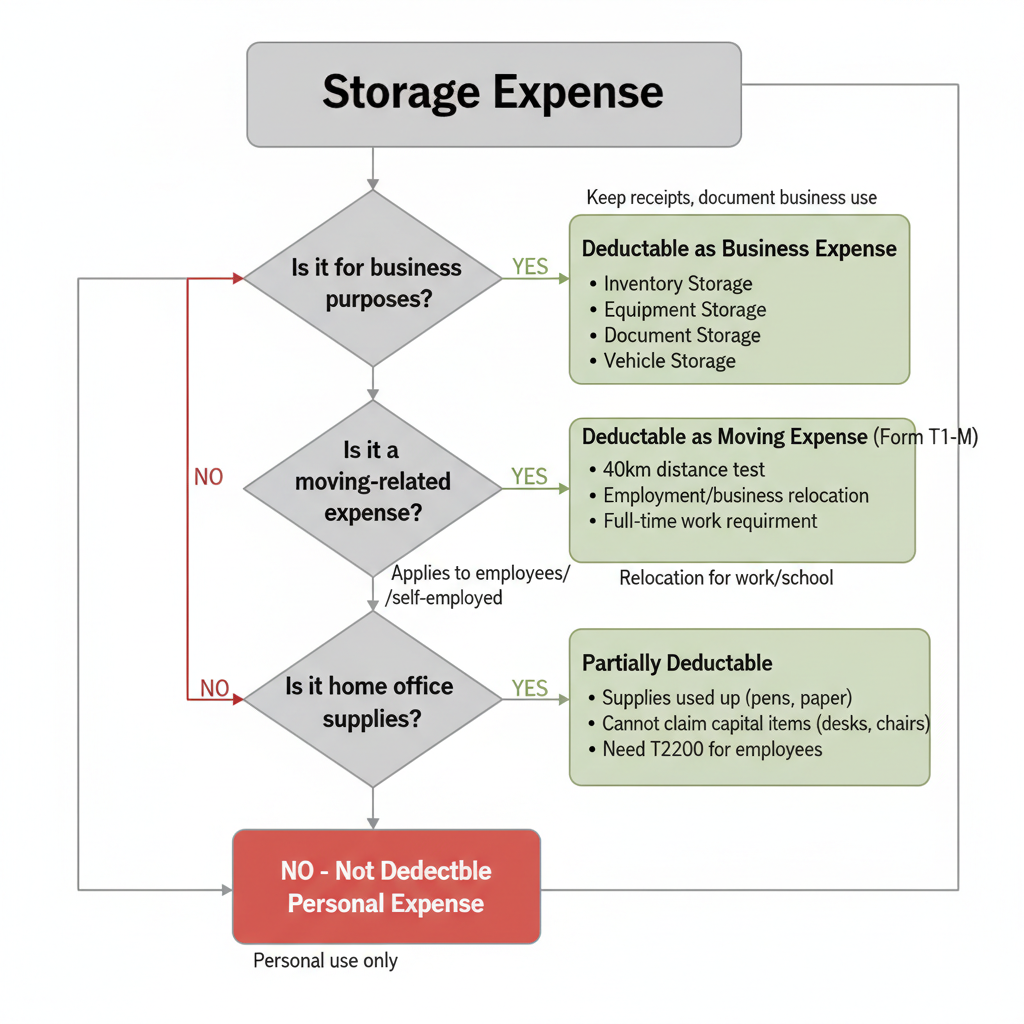
The most important distinction is between personal use and income related use. Storing household furniture, seasonal decorations, or items kept purely for convenience is treated as a personal expense and cannot be deducted. However, when a storage unit is used to hold business inventory, equipment, work documents, or belongings during an eligible work related move, the CRA views the cost as an income related expense that may qualify for a deduction.
How Businesses can write Off Storage costs?
Storage becomes a deductible business expense when it plays a clear role in helping you earn income. Whether you operate a small retail shop, an online store, or a service based business, off site storage can often be justified as a necessary operating cost when your main workspace cannot accommodate everything you need.
Storing Inventory and Work Tools
Businesses that keep inventory, tools, or supplies in a storage unit can usually deduct the full rental cost when those items are required for daily operations. This includes ecommerce sellers storing merchandise, contractors storing tools, and service providers holding materials that do not fit in their primary office.
To support the deduction, it is important to maintain records showing that the items inside the unit are business related and used to generate revenue. Receipts, photos, and simple inventory lists help establish this connection.
Keeping Business Records Off Site
Storing invoices, tax records, client files, and contracts in a secure storage unit can qualify as a deductible expense. The CRA requires businesses to retain records for several years, and many owners use off site units to stay compliant without cluttering their workspace.
These costs remain deductible even if the business has stopped operating, as long as the storage exists to meet record retention obligations. Clear documentation of the purpose of the storage is essential.
Housing Vehicles and Specialized Equipment
Some businesses rely on vehicles, machinery, or seasonal gear that cannot be kept at home or in a small office. Landscaping companies, moving services, and trades often use storage units to hold trailers, equipment, and commercial vehicles between jobs or seasons.
When the unit is used exclusively for business assets, the rental fees can be deducted in full. As always, keeping evidence of business use will protect the claim in the event of a review.
Handling Mixed Personal and Business Storage
Problems arise when a single storage unit contains both personal and business items. In this situation, the CRA allows only the business portion of the expense to be deducted.
You must reasonably calculate the percentage of the unit used for business and apply that ratio to the total cost. Photographs, written notes, and clear separation of items make it much easier to justify the allocation if the CRA questions the deduction.
How to Claim Storage Costs When You Move for Work
Storage expenses can also be deducted when they are part of an eligible work related move. The CRA recognizes that moving for employment or business often requires temporary storage of household items and allows these costs when strict conditions are met.
Meeting the CRA Distance and Time Requirements
To qualify, your new work location must be at least forty kilometres closer to your new home than your old job was to your former residence. This distance is measured using the shortest normal public route, not by straight line.
You must also satisfy the employment duration test. Employees need to work full time for at least thirty nine weeks during the twelve months following the move. Self employed individuals must meet an even higher threshold of seventy eight weeks of full time work within the first twenty four months.
Storage Costs That Are Allowed
The CRA permits deductions for temporary storage of household belongings that occurs during the moving process. This includes short term storage while goods are in transit, as well as reasonable insurance that protects your items during this period.
Transportation of your belongings, packing materials, and travel related expenses may also be included as part of your moving expense claim, provided they are directly linked to the relocation for work or school.
Carrying Forward Unused Moving Expenses
In some cases your moving expenses may be higher than the income you earn at your new location in the year of the move. When this happens, you cannot deduct the full amount right away.
The unused portion does not disappear. You may carry it forward indefinitely and claim it in future years, as long as you are earning income from the same new work location.
Home Office Storage and Work Space in Home Expenses
Home office related deductions can include certain storage and workspace costs, but the rules depend heavily on whether you are an employee or self employed. The CRA focuses on whether the expense is required to earn income and whether it is properly supported by the right forms and reasonable calculations.
Employees Using Form T2200
Employees may deduct certain home office storage related costs only if their employer requires them to work from home and completes Form T2200. In this case, only consumable supplies that are used up in the course of work such as paper, ink, envelopes, and similar items are deductible, while capital items such as desks, filing cabinets, computers, and storage furniture must be claimed under capital cost allowance rules rather than as current expenses.
Self Employed Home Office Rules
Self employed individuals face fewer restrictions but must show that the home office is their principal place of business or that they use it exclusively to meet clients on a regular basis. Once eligible, they may deduct a reasonable portion of expenses related to the space including utilities, insurance, and maintenance, but the total deduction cannot exceed their net business income for the year.
What Storage Expenses are not Deductible?
Most storage expenses in Canada are personal in nature and therefore cannot be deducted. If you rent a unit simply to declutter your home, store extra furniture, or keep personal belongings that are not related to earning income, the CRA considers these costs to be personal living expenses.
Items such as holiday decorations, old clothing, household furniture, or memorabilia do not qualify for tax deductions, even if the storage unit is used long term or is expensive. The fact that an item is inconvenient to store at home does not make it deductible.
There are very limited exceptions, usually tied to disasters such as fires or floods that make your home temporarily uninhabitable. In those rare cases, storage costs may be considered necessary rather than optional, but strong documentation is required to prove the emergency nature of the situation.
CRA Forms You Need to Claim Storage Deductions
Different types of storage deductions require different CRA forms, and using the wrong one can result in your claim being denied. Self employed individuals and business owners report storage costs on Form T2125 as part of their business or professional activities, listing the expense under rent or other relevant cost categories.
When storage is claimed as part of a work related move, you must calculate the eligible amount using Form T1 M and then transfer the total to your personal tax return. This form is not submitted with your return, but all receipts must be kept in case the CRA requests proof.
Employees who claim home office related storage or supply expenses must have their employer complete Form T2200 to certify that they were required to pay for those costs as part of their job. Without this form, the CRA will generally disallow the deduction.
Documentation and Audit Proof Tips
Strong documentation is the key to successfully claiming storage deductions in Canada. Always keep copies of your rental agreements, monthly receipts, and any invoices related to the storage unit, and store them both digitally and in paper form so they are easy to retrieve if the CRA asks for evidence.
In addition to receipts, it is wise to keep photos of the contents of your unit along with short written notes explaining how the stored items relate to your business or move. This simple justification file can make the difference between a smooth review and a denied claim during an audit.
Tax Planning Tips to Maximize Your Deduction
Timing matters when it comes to claiming storage expenses, especially for moving related deductions. If you move late in the year but earn very little income at your new location before December, your deduction will be limited and you may have to carry part of it forward, delaying the tax benefit.
For storage units used partly for business and partly for personal purposes, careful documentation is essential. Keep written records showing what percentage of the unit is used for income related items and support this with photos and simple inventory lists so your allocation appears reasonable.
One of the most common mistakes is claiming the full cost of a mixed use storage unit without calculating a business portion. This often triggers CRA questions because personal use is not deductible under normal circumstances.
Another frequent audit trigger is poor record keeping. Missing receipts, vague descriptions such as storage for business, or inconsistent claims from year to year can all raise red flags and lead to denied deductions.
Turn Storage Costs Into Smart Tax Savings
Storage expenses are one of the most misunderstood areas of Canadian tax deductions, yet they offer real opportunities for savings when used correctly. Business owners, self employed individuals, and people who relocate for work can all benefit from understanding when storage becomes an income related expense rather than a personal one.
Before the next tax season arrives, review how you are using your storage space, gather your documentation, and confirm which CRA forms apply to your situation. A little preparation today can translate into meaningful deductions tomorrow while keeping your return accurate and defensible.