
![Canadian Self-Storage Market Trends for 2026 [Growth, Risks, and Opportunities]](/assets/images/blog/canadian-self-storage-market-trends-2026-featured.jpg)
The Canadian self storage market has evolved from a niche real estate segment into a core component of the national property landscape. Thousands of facilities now serve households, students, retirees, and small businesses that rely on storage as an extension of their living or working space. Rising housing costs, smaller apartments, and increased mobility have steadily expanded demand across the country, pushing the industry toward record levels of activity and investment.
The year 2026 is shaping up to be a defining moment for the sector. A surge of new supply is set to enter the market at the same time that consumer expectations are changing and competition is intensifying in major urban centres. This article explores the forces behind these shifts and delivers practical insights to help operators and investors understand where the real opportunities lie and how to prepare for the next stage of growth.
Canadian Self-Storage Market Overview
The Canadian self storage market continues to expand steadily and is now valued at approximately four to five billion dollars as of 2025. Industry analysts expect this figure to rise further in 2026 as new facilities come online and occupancy levels remain resilient despite broader economic uncertainty.
Canada is currently home to more than three thousand four hundred self storage facilities offering roughly one hundred sixteen million square feet of rentable space. This equals an average of about three point two square feet of storage per person nationwide which highlights how underdeveloped the sector still is in many regions.
When compared with the United States the gap becomes even clearer. American markets average more than eight square feet of storage per capita meaning Canada operates at less than half the penetration rate of its southern neighbour. This structural difference is one of the strongest indicators that the Canadian self-storage industry still has significant room to grow in the years following 2026.
Why Self-Storage Supply is set to Double in 2026?
Self storage supply in Canada is expected to double in 2026 because a large number of development projects that were planned several years ago are finally reaching completion. Many of these facilities entered the pipeline between 2021 and 2023 when demand surged and capital was readily available, creating a wave of new inventory that is now arriving almost simultaneously.
Construction delays caused by pandemic disruptions pushed back delivery timelines across the country. Rising material costs, labor shortages, and municipal permitting slowdowns extended development cycles well beyond original schedules, which compressed several years of new supply into a much shorter window.
The strongest growth is concentrated in British Columbia, Alberta, and parts of Ontario, with Vancouver, Calgary, and Toronto absorbing the majority of new square footage. These urban markets are seeing the heaviest build activity as developers target high population density areas where long term storage demand is considered most reliable.
Regional Market Breakdown
Regional performance across Canada is becoming increasingly uneven, with some provinces facing mounting competitive pressure while others are only beginning to unlock their long term potential.
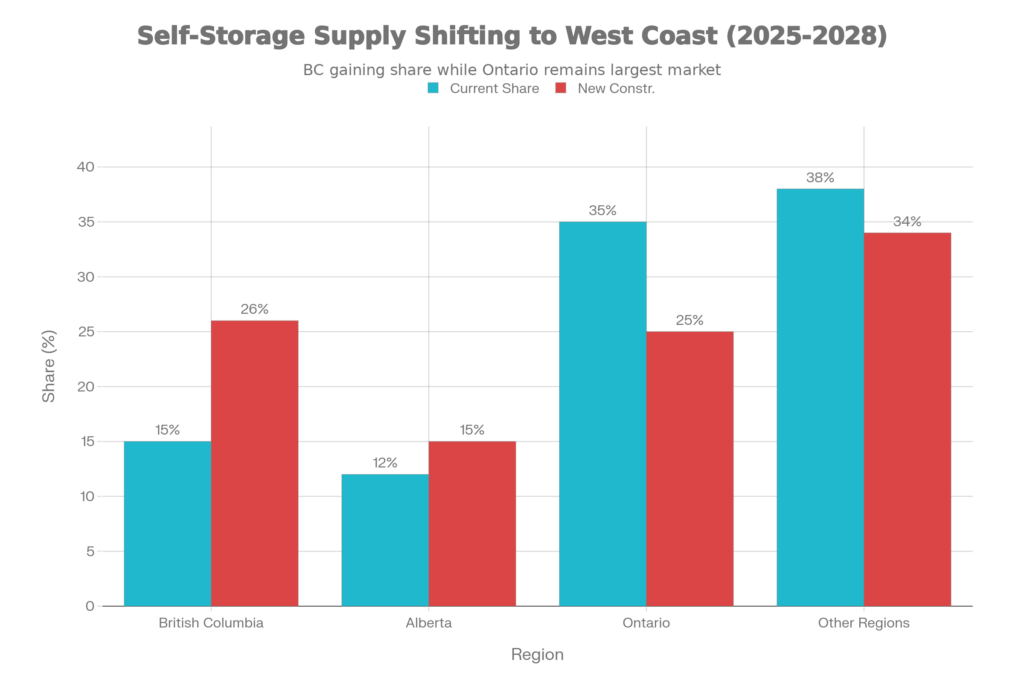
British Columbia Oversupply Risks
British Columbia is showing early signs of oversupply, particularly in Vancouver and the Lower Mainland where a disproportionate share of new developments has been delivered. These dense urban pockets are absorbing large volumes of new units in a short period of time, placing pressure on both occupancy and pricing.
As more facilities compete for the same customer base, rental growth in parts of British Columbia has slowed and promotional activity is becoming more common. Operators are now forced to focus on marketing efficiency and customer retention rather than relying on organic demand growth.
Alberta A Bright Spot
Alberta continues to stand out as one of the healthiest self storage markets in the country, with Calgary maintaining solid demand and Edmonton experiencing only localized pressure in certain corridors. Compared with coastal cities, Alberta benefits from lower land costs, faster approvals, and less development congestion.
Interprovincial migration from British Columbia and Ontario into Alberta is further strengthening demand, as households seek more affordable living options and require transitional storage. This steady inflow supports both residential and small business usage of storage units.
Saskatchewan and Manitoba Emerging Markets
Saskatchewan and Manitoba remain underpenetrated markets with very limited self storage inventory relative to their populations. Many cities in these provinces still operate with minimal square footage per capita, creating a supply gap that is attractive for developers.
With lower competition, cheaper land, and fewer institutional operators, these Prairie markets present strong opportunities for new builds that can achieve rapid lease up and healthy rental growth over the medium term.
Key Demand Drivers Shaping the Market
Several powerful social and economic forces are reshaping demand for self storage across Canada. An aging population is downsizing into smaller homes and condos, creating the need for off site space to store personal belongings. At the same time, high levels of migration and immigration generate transitional storage demand as people relocate between cities or provinces.
Housing affordability is also pushing developers to build smaller apartments, leaving residents with limited in home storage. This trend overlaps with the rapid growth of small businesses and ecommerce entrepreneurs who increasingly rely on storage units as flexible inventory hubs rather than committing to expensive commercial leases.
Financial Performance and Industry Health
Leading operators such as StorageVault have continued to report solid financial performance despite a more challenging economic environment. Same store revenue growth has remained positive, supported by stable occupancy levels and disciplined pricing strategies that prioritize long term value over short term promotions.
Across the sector, revenue and net operating income trends point to a healthy industry that is normalizing after the rapid expansion seen during the pandemic years. Rental growth has moderated to more sustainable levels, yet operators are still achieving consistent increases through improved revenue management and a growing base of commercial users.
One of the most attractive features of the self storage business is its resilience during economic cycles. Periods of relocation, downsizing, and business restructuring often increase the need for storage, allowing the sector to perform well even when other segments of commercial real estate experience volatility.
Pricing, Competition, and Consumer Behavior
Pricing strategies in the Canadian self storage market are becoming more disciplined as operators move away from heavy discounts and rapid rent increases. Several large brands have shifted toward steadier rate adjustments and longer promotional periods after seeing that extreme introductory offers often led to high tenant turnover and weaker lifetime customer value.
Canadian consumers have also shown clear resistance to aggressive tactics that feel misleading, such as ultra low move in prices followed by sudden fee add ons or sharp rent hikes within the first few months. In Quebec, for example, a class action lawsuit against a major operator over advertised one dollar move in specials highlighted growing frustration with opaque pricing, reinforcing the industry wide preference for transparent and predictable billing.
Technology and Security as Growth Catalysts
Technology is rapidly transforming how Canadian self storage facilities operate, with artificial intelligence and automation now embedded into daily workflows. Modern management platforms allow operators to optimize pricing, handle reservations online, and manage customer communication without relying on large on site teams.
Automation is also improving the customer experience through mobile access systems, digital leases, and contactless payments. These tools reduce friction for tenants while helping operators lower administrative costs and scale operations more efficiently.
Security has become one of the most important differentiators in competitive markets, as customers increasingly store higher value personal and business items. Facilities that invest in visible and proactive protection systems are earning stronger brand trust and higher retention rates.
Key security features now being incorporated include 24 hour video surveillance, AI assisted camera monitoring, gated entry with personalized access codes, real time incident alerts, and on site or remote live monitoring teams.
What 2026 Means for Operators and Investors?
The year 2026 will likely mark a shift from rapid expansion to performance driven growth in the Canadian self storage industry. Operators should expect more competitive leasing conditions in some urban markets, particularly where new supply is concentrated, while secondary and emerging regions may continue to benefit from strong demand and limited inventory.
For facility operators, the focus will move toward optimizing existing assets rather than building aggressively. Improving tenant retention, refining pricing systems, and investing in technology that enhances customer experience will be more important than simply adding new locations.
Investors should tailor their strategies to regional fundamentals, favoring stable operators in primary markets and pursuing higher growth opportunities in underpenetrated provinces such as Alberta, Saskatchewan, and Manitoba. Disciplined capital allocation and local market expertise will be essential to capturing long term value.
Preparing Today for the Future of Canadian Self Storage
As 2026 approaches, the Canadian self storage market stands at a turning point shaped by rising supply, uneven regional performance, and evolving consumer expectations. Oversupply risks in some urban centres contrast with strong growth potential in underpenetrated Prairie markets, while technology and transparent pricing are becoming decisive competitive advantages. These conditions create both opportunity and risk for anyone active in the sector.
Now is the time for operators and investors to reassess their strategies, strengthen operational systems, and align with markets that offer sustainable demand rather than short term hype. Those who act today will be best positioned to thrive in the next phase of this fast maturing industry.